2008年12月19日星期五

Morris & Co.


Early years
Morris, Marshall, Faulkner & Co., "Fine Art Workmen in Painting, Carving, Furniture and the Metals," was jointly created by Morris, Ford Madox Brown, Edward Burne-Jones, Charles Faulkner, Dante Gabriel Rossetti, P. P. Marshall, and Philip Webb in 1861 to create and sell medieval-inspired, handcrafted items for the home. The prospectus set forth that the firm would undertake carving, stained glass, metal-work, paper-hangings, chintzes (printed fabrics), and carpets.The first headquarters of the firm were at 8 Red Lion Square.
The work shown by the firm at the 1862 International Exhibition attracted much notice, and within a few years it was flourishing. In the autumn of 1864 a severe illness obliged Morris to choose between giving up his home at Red House in Kent and giving up his work in London. With great reluctance he gave up Red House, and in 1865 established himself under the same roof with his workshops, now relocated to larger premises in Queen Square, Bloomsbury.
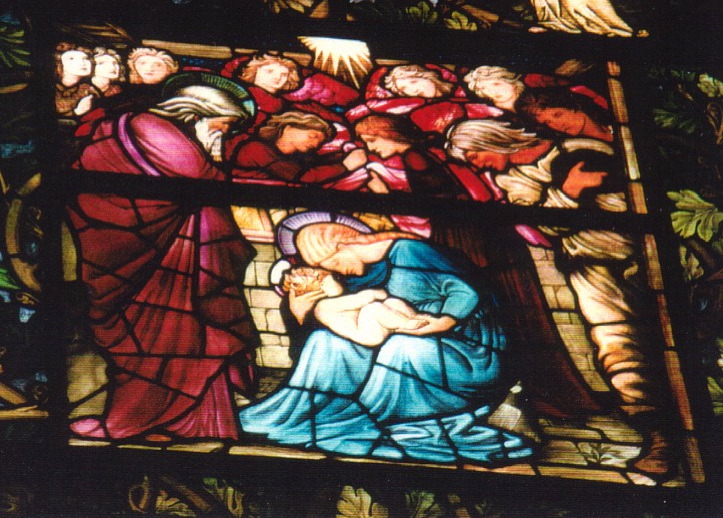
The decoration of churches was from the first an important part of the business. A great wave of church-building and remodeling by the Church of England in the 1840s and 1850s increased the demand for ecclesiatical decoration of all kinds, especially stained glass. But this market shrank in the general despression of the later 1860s, and the firm increasingly turned to secular commissions. On its non-ecclesiastical side, the product line was extended to include, besides painted windows and mural decoration, furniture, metal and glass wares, cloth and paper wall-hangings, embroideries, jewelery, woven and knotted carpets, silk damasks, and tapestries.
Morris was producing repeating patterns for wallpaper as early as 1862, and some six years later he designed his first pattern specifically for fabric printing. As in so many other areas that interested him, Morris chose to work with the ancient technique of hand woodblock printing in preference to the roller printing which had almost completely replaced it for commercial uses.

Reorganization and expansion
In August 1874, Morris determined to restructure the partnership, generating a dispute with Marshall, Rossetti, and Madox Brown over the return on their shares. The company was dissolved and reorganized under Morris's sole ownership as Morris & Co. on 31 March 1875.
During these years, Morris took up the practical art of dyeing as a necessary adjunct of his manufacturing business. He spent much of his time at Staffordshire dye works mastering the processes of that art and making experiments in the revival of old or discovery of new methods. One result of these experiments was to reinstate indigo dyeing as a practical industry, and generally to renew the use of those vegetable dyes, like madder, which had been driven almost out of use by the anilines.
Dyeing of wools, silks, and cottons was the necessary preliminary to what he had much at heart, the production of woven and printed fabrics of the highest excellence; and the period of incessant work at the dye-vat (1875–76) was followed by a period during which he was absorbed in the production of textiles (1877–78), and more especially in the revival of carpet-weaving as a fine art

In June of 1881, Morris relocated his dyeworks from Queen Square to an early eighteenth-century silk-throwing works at Merton Abbey Mills, after determining that the water of the River Wandle was suitable for dyeing. The complex, on seven acres, included several buildings and a dyeworks, and the various buildings were soon adapted for stained-glass, textile printing, and fabric- and carpet-weaving.
In 1879, Morris had taught himself tapestry weaving in the medieval style and set up a tapestry workshop with his apprentice John Henry Dearle at Queen Square. Dearle executed Morris and Co.'s first figural tapestry from a design by Walter Crane in 1883. Dearle was soon responsible for the training of all tapestry apprentices in the expanded workshop at Merton Abbey, and partnered with Morris on designing details such as fabric patterns and floral backgrounds for tapestries based on figure drawings or cartoons by Burne-Jones (some of them repurposed from stained glass cartoons). and animal figures by Philip Webb. Suites of tapestries were made as part of whole-house decorating schemes, and tapestries of Burne-Jones angels and scenes from the Arthurian legends were a staple of Morris & Co. into the twentieth century.

Important Commissions
Two significant secular commissions helped establish the firm's reputation in the late 1860s: a royal project at St. James's Palace and the "green dining room" at the South Kensington Museum (now the Victoria and Albert) of 1867. The green dining room (preserved as the Morris Room at the V&A) featured stained glass windows and panel figures by Burne-Jones, panels with branches of fruit or flowers by Morris, and olive branches and a frieze by Philip Webb. The St. James's commission comprised decorative schemes for the Armoury and the Tapestry Room, and included panels of stylized floral patterns painted on ceilings, cornices, dados, windows, and doors.
In 1871 Morris & Co. were responsible for the windows at All Saints church in the village of Wilden near to Stourport-on-Severn. They were designed by Edward Burne-Jones for Alfred Baldwin, his wife's brother-in-law.
Standen near East Grinstead, West Sussex was designed between 1892 and 1894 by Philip Webb for a prosperous London solicitor, James Beale, his wife Margaret, and their family. It is decorated with Morris carpets, fabrics and wallpapers.
Stanmore Hall was the last major decorating commission executed by Morris & Co. before Morris's death in 1896. It was also the most extensive commission undertaken by the firm, and included a series of tapestries based on the story of the Holy Grail for the dining room, to which Morris devoted his energies, the rest of the work being exeuted under the direction of Dearle.
Other Morris & Co. commissions include the ceiling within the dining room of Charleville Forest Castle, Ireland and interiors of Bullers Wood House, now Bullers Wood School in Chislehurst, Kent.

Last stages

As Morris pursued other interests, notably socialism and the Kelmscott Press, day-to-day work at the firm was delegated. Morris's daughter May became the director of the embroidery department in 1885, when she was in her early twenties. Dearle, who had begun designing repeating patterns for wallpapers and textiles in the late 1880s, was head designer for the firm by 1890, handling interior design commissions and supervising the tapestry, weaving, and fabric-printing departments at Merton Abbey
Dearle's contributions to textile design were long overshadowed by Morris. Dearle exhibited his designs under the Morris name rather than his own in the Arts and Crafts Exhibitions and the major Morris retrospective of 1899, and even today many Dearle designs are popularly offered as "William Morris" patterns.
On Morris's death in 1896, Dearle became Art Director of the firm, which changed its name again to Morris & Co. Decorators Ltd. in 1905.Dearle managed the company's textile works at Merton Abbey until his own death in 1932. The firm was finally dissolved in the early months of World War II.



Grilling

In the US and Canada
In the United States and Canada, use of the word refers to cooking food directly over a source of dry heat, typically with the food sitting on a metal grate that leaves "grill marks." In the UK and other Commonwealth countries this would be referred to as barbecueing, although grilling is usually faster and hotter than the American sense of the word "barbecue," which does not necessarily imply grill marks. Grilling is usually done outdoors on charcoal grills or gas grills, a recent trend is the concept of infrared grilling. Grilling may also be performed using stove-top "grill pans" which have raised metal ridges for the food to sit on, or on an indoor electric grill.
Similar to a grill/broiler is a "salamander", which is most frequently used in a professional kitchen. It is smaller than a standard grill/broiler, and is used to finish off dishes, such as caramelizing the sugar on a Crème brûlée.
The flame-grilling machine at Burger King restaurants is called a 'Broiler' in the US. It works by moving meat patties along a chain conveyor belt between top and bottom burners, 'grilling' from both sides.
In 1898, the Bridge & Beach Manufacturing Co., St. Louis, MO., started manufacturing a vertical cast iron stove. These stoves were designed so that the meat could be flame-broiled quickly from both sides of the stove at the same time. Hinged steel wire gridirons were designed for use in the vertical broilers to hold the meat in place while it cooked. The gridirons were slid in and out of the stoves like modern day oven racks and the stoves took up a small amount of counter space. These stoves were used in lunch wagons to feed factory workers.
A skewer or brochette, or a rotisserie may link smaller portions of food into this process. The resulting food product is often called a kabob or kabab or satay.
Mesquite or hickory wood chips (damp) may be added on top of the coals to allow a smoldering effect that provides additional flavor to the food. Other hardwoods such as pecan, apple, maple and oak may also be used.
What gives grilled meat the taste is a chemical process called the Maillard reaction. This process is the term for the browning of meat. The Maillard reaction, along with the flavors imparted by a wood or charcoal fire, is what sets grilling apart from other methods of cooking meat.
Barbecue and barbecuing are a way of cooking meat using the indirect heat and smoke from a wood or charcoal fire in a barbecue pit or smoker. Barbecuing is the slow smoking of tough cuts of meat. Grilling is a method of cooking more tender meats using the direct heat of a fire with the meat over the fire.
For example, a beef brisket is a meat cut often hot smoked or barbecued at 240-270F for 8 to 12 hours. A brisket is not a cut of beef that lends itself to being grilled.
Two of the largest manufacturers of backyard grills in North America call their products 'grills' and not barbecues. See www.charbroil.com or www.weber.com.
Infrared grilling is a new method among grilling enthusiasts, using direct heat from propane or natural gas it heats the food directly at temperatures over 900F. Also called Sear-Grilling.

In the UK
In the United Kingdom and Commonwealth countries (except Canada), grilling generally refers to cooking food directly under a source of direct, dry heat. The "grill" is usually a separate part of an oven where the food is inserted just under the element. This practice is referred to as "broiling" in North America. In electric ovens, grilling may be accomplished by placing the food near the upper heating element, with the lower heating element off and the oven door partially open. Grilling in an electric oven may create much smoke and cause splattering in the oven.Gas ovens often have a separate compartment for grilling, as a drawer below the flame.

In Asia
In any Japanese city a yakitori cart or shop with charcoal-fired grills and flavorful marinated grilled meat on a stick can be found on many streets. See also yakiniku. The meat is grilled directly over hot charcoal coals at high temperature. The same can be found in most Asian countries, such as China and Korea, many use a small charcoal grill to cook meats and vegetables. In Malaysia, Singapore and Indonesia, a favorite food item from food vendors is the famous Satay, marinated meat on a bamboo skewer grilled over a charcoal fire and served with peanut (sate) sauce.

Direct and indirect cooking
There are two methods to grill food over a gas, wood, charcoal, or infrared - direct or indirect cooking. For the devices used to grill see Grill (cooking). Using the direct heat method, the food item is placed directly over the flame or coals. This method exposes the food item to very hot temperatures, often in excess of 500F or 900F for infrared grills. This is the fastest way to cook food items on a grill. The food items are cooked by the flames and radiant heat coming from the heat source of the grill. The direct heat method is used for grilling steaks, hamburgers, hot dogs, sausage, pork chops and skewers. The food items must be carefully monitored so as to not burn them.
Using indirect heat, you place the food item so that it is not directly over flames or coals. This is done by having the fire or coals on only one section of the grill and placing the food item on a part of the cooking grill opposite the flames or coals - for example, having the burners going on the right side of a gas grill but off on the left side or placing the coals on the right side of the grill and no coals on the left side. In a charcoal grill, when indirect grilling it is best to place a foil pan of water under the food to keep it from drying out. Using the indirect grilling method is best for large cuts of meat or bone-in poultry. It allows the food to cook all the way through without burning or charring on the outside of the meat.
Cooking meat at high temperatures, such as broiling/grilling or barbecuing, can lead to the formation of heterocyclic amines, which are carcinogens.

Flattop grilling
A flattop grill is a cooking appliance that resembles a griddle but performs differently because the heating element is circular rather than straight (side to side). This heating technology creates an extremely hot and even cooking surface, as heat spreads in a radial fashion over the surface.
The first flattop grills originated in Spain and are known as planchas or la plancha. Food that is cooked “a la plancha” means “grilled on a metal plate.” Plancha griddles or flat tops are chrome plated which prevents reaction with the food. Some base metal griddles will depart a subtle flavor to the food you're cooking. Also, with a planch if you use a low even heat and a drop of oil you can toast the food and carmelize some of the natural sugars in the food. For example, Filetes a la plancha translates to Grilled Beef Fillets. You will also find many la plancha recipes in Cuisine of Chile and Cuban cuisine.
The flattop grill is a versatile platform for many cooking techniques such as sautéing, toasting, steaming, stir frying, grilling, flambé and roasting. In addition, pots and pans can be placed directly on the cook surface, giving more cooking flexibility. In most cases, the steel cooksurface seasons like cast iron cookware, providing a natural non-stick surface.


Biodegradable Packing Material


heat press mug


Ratchet Tie Downs


Microwave Oven Bracket


Self Aligning Bearings


Bamboo Folding Chairs


DVB-T USB Receiver


threaded steel rod


CCTV Color Monitor


Nylon Fishing Line


replica wrist watches


hair extension kit


UHF TV Antenna


led under-cabinet light


jeep leaf springs


corrugated board box


nonstick broiler pan


Stained Glass Craft


floating golf balls


inflatable water ball


Polar Fleece Coat


Handmade Fabric Handbags


Double Wall Corrugated


evil eye beads


acrylic plastic beads


Short Sleeve Blouse


cotton children socks

Corrugated fiberboard

History
In the mid-19th century, an ingenious concept enabled flimsy sheets of paper to be transformed into a rigid, stackable and cushioning form of packaging for delicate goods in transit.
Corrugated (also called pleated) paper was patented in England in 1856, and used as a liner for tall hats, but corrugated boxboard would not be patented and used as a shipping material until December 20, 1871. The patent was issued to Albert Jones of New York City for single-sided (single-face) corrugated board. Jones used the corrugated board for wrapping bottles and glass lantern chimneys. The first machine for producing large quantities of corrugated board was built in 1874 by G. Smyth, and in the same year Oliver Long improved upon Jones' design by inventing corrugated board with liner sheets on both sides.This was now corrugated board as we know it today.
The Scottish-born Robert Gair invented the corrugated box in 1890; that is, pre-cut flat pieces manufactured in bulk that folded into boxes. Gair's invention, as with so many other great innovations, came about as a result of an accident: he was a Brooklyn printer and paper-bag maker during the 1870s, and one day, while he was printing an order of seed bags, a metal ruler normally used to crease bags shifted in position and cut them. Gair discovered that by cutting and creasing bags in one operation he could make prefabricated paper boxes. Applying this idea to corrugated boxboard was a straightforward development when the material became available. By the start of the 20th century, corrugated boxes began replacing the custom-made wooden crates and boxes previously used for trade.
The corrugated box was initially used for packaging glass and pottery containers, which are easily broken in transit. Later, the case enabled fruit and produce to be brought from the farm to the retailer without bruising, improving the return to the producers and opening up hitherto unaffordable export markets. (There had previously been a great deal of waste when, for example, oranges were craned out of the hold of a ship, having been bulk loaded into it.)

Manufacture of Corrugated Board
Corrugated board is manufactured on large high-precision machinery lines called corrugators running at 500 lineal feet per minute or faster. These machines over time have become very complex with the objective to avoid some common problems in corrugated board production, such as warp and washboarding. In the classical corrugator the paper is humidified by means of high pressure steam. The humidity aims to soften the paper fibres so that the formation of the flute and the consequent glueing will go smoothly. The process adds a considerable amount of water to the papers. After the formation of the board this humidity has to be removed by drying in the so-called dry-end. Here the newly formed corrugated board is heated from the bottom by hot plates. On the top various pressures are applied by a load system on the belt.
The corrugated medium is usually a 26 lb/1000 sq ft (127 g/m2) paperboard; higher grades are also available. It arrives to the corrugator on large rolls. At the single-facer, it is heated, moistened, and formed into a fluted pattern on geared wheels. This is joined to a flat linerboard with a starch based adhesive to form single face board. At the double-backer, a second flat linerboard is adhered to the other side of the fluted medium to form single wall corrugated board. Linerboards are often kraft paperboard (of various grades) but may be bleached white, mottled white, colored, or preprinted.
Common flute sizes are "A", "B", "C", "E" and "F" or microflute. The letter designation relates to the order that the flutes were invented, not the relative sizes. Flute size refers to the number of flutes per lineal foot, although the actual flute dimensions for different corrugator manufacuturers may vary slightly. Measuring the number of flutes per lineal foot is a more reliable method of identifying flute size than measuring board thickness, which can vary due to manufacturing conditions. The most common flute size in corrugated boxes is "C" flute.
Box Manufacture
Boxes can be formed in the same plant as the corrugator. Alternatively, sheets of corrugated board may be sent to a different manufacturing facility for box fabrication.
The corrugated board is creased or scored to provide controlled bending of the board. Most often, slots are cut to provide flaps on the box. Scoring and slotting can also be accomplished by die-cutting.
The "Flexo Folder Gluer" is a machine that in one single pass prints, cuts, folds, and glues flat sheets of board to convert them to boxes for any application, from storing old family pictures to shipping the biggest of plasma TV sets to the global market. The most advanced of FFG's can run at speeds of up to 26,000 boxes per hour (about 433 per minute).
The most common box style is the Regular Slotted Container. All flaps are the same length and the major flaps meet in the center of the box.
The manufacturer's joint is most often joined with adhesive but may also be taped or stitched. The box is shipped flat (knocked down) to the packager who sets up the box, fills it, and closes it for shipment. Box closure may be by tape, adhesive, staples, strapping, etc.
Many other styles of corrugated boxes and structures are available:
A Full Overlap Box is similar to an RSC except the major flaps fully overlap.
A Half Slotted Container (HSC) Bottom or top normally used as a shroud (cap) or base (btm)
A Five Panel Folder is shipped flat to a packager without a manufacturer's joint and is often used for long items. The box has five long panels, one of which fully overlaps. The ends also fully overlap.
A Full Telescope Box has two fully telescoping sections. The sections may be formed by staples, die-cut locks, adhesive, etc.
A Partial Telescope Box has two sections. The top telescopes partially over the bottom.
A corrugated tray is often used for display purposes or used with a shrink wrap
Corrugated corner pads can be used for product support and cushioning
Special die-cut shapes have almost endless designs and uses.
etc
The size of a box can be measured for either internal (for product fit) or external (for handling machinery or palletizng) dimensions. Boxes are usually specified and ordered by the internal dimensions.
Box styles in Europe are typically defined by a 4-digit code specified by FEFCO: for example a regular slotted container (RSC) is coded 0201. FEFCO styles are normally the basis for more complicated special designs that incorporate, for example, locking tabs or internal fittings.

Single-Face Laminate
A limitation of common corrugated material has been the difficulty in applying fine graphic print for informative and marketing purposes. The reasons for this stem from the fact that prefabricated corrugated sheets are relatively thick and spongy, compared to the thin and incompressible nature of solid fibre paper such as paperboard. Due to these characteristics of corrugated, it has been mainly printed using a flexographic process, which is by nature a coarse application with loose registration properties.
A more recent development popular in usage is a hybrid product featuring the structural benefits of corrugated combined with the high-graphics print of lithography previously relegated to paperboard folding cartons. This application, generally referred to as 'Single-Face Laminate', begins its process as a traditional fluted medium adhered to a single linerboard (single-face), but in place of a second long-fibered liner, a pre-printed sheet of paperboard such as SBS (solid bleached sulfate) is laminated to the outer facing. The sheet can then be converted with the same processes used for other corrugated manufacturing into any desired form.
Specialized equipment is necessary for the material construction of SFL, so users may expect to pay a premium for these products. However, this cost is often offset by the savings over a separate paperboard sleeve and the labor necessary to assemble the completed package.

Box design
Packaging engineers design corrugated boxes to meet the particular needs of the product being shipped, the hazards of the shipping environment, (shock, vibration, compression, moisture, etc), and the needs of retailers and consumers.
Recycling
Old corrugated containers are an excellent source of fibre for recycling. They can be compressed and baled for cost effective transport to anywhere in need of fibre for papermaking. The baled boxes are put in a hydropulper which is a large vat of warm water for cleaning and processing. The pulp slurry is then used to make new paper and fiber products.
Mill and corrugator scrap, or broke, is the cleanest source for recycling. The high rates of post-consumer recycling reflect the efficiency of recycling mills to clean and process the incoming materials. Several technologies are available to sort, screen, filter, and chemically treat the recycled paper.
Many extraneous materials are readily removed. Twine, strapping, etc are removed from the hydropulper by a "ragger". Metal straps and staples can be screened out or removed by a magnet. Film-backed pressure sensitive tape stays intact: the PSA adhesive and the backing are both removed together
Materials which are more difficult to remove include wax coatings on corrugated boxes and "stickies", soft rubbery particles which can clog the paper maker and contaminate the recycled paper. Stickies can originate from book bindings, hot melt adhesives, PSA adhesives from paper labels, laminating adhesives of reinforced gummed tapes, etc.
Recycling corrugated fiberboard helps conserve natural resources and energy. It also helps countries without sustainable wood resources build a paper and packaging industry locally and develop their exports to global markets. Over 70% of the corrugated manufactured is recovered, recycled and made into new corrugated products throughout the world.


Biodegradable Packing Material


heat press mug


Ratchet Tie Downs


Microwave Oven Bracket


Self Aligning Bearings


Bamboo Folding Chairs


DVB-T USB Receiver


threaded steel rod


CCTV Color Monitor


Nylon Fishing Line


replica wrist watches


hair extension kit


UHF TV Antenna


led under-cabinet light


jeep leaf springs


corrugated board box


nonstick broiler pan


Stained Glass Craft


floating golf balls


inflatable water ball


Polar Fleece Coat


Handmade Fabric Handbags


Double Wall Corrugated


evil eye beads


acrylic plastic beads


Short Sleeve Blouse


cotton children socks


curtain fabric silk

Jeep Cherokee (XJ)


1984-1996
The XJ Cherokee was introduced in 1984 as the first unibody Jeep. Designs of the XJ Cherokee date back to 1978 when a team of American Motors (AMC) and Renault engineers drew several sketches. A few clay models were based on the existing SJ Cherokee. Early sketches of the XJ Cherokee had an European influence, and most of the styling cues were done by AMC engineers. The ongoing debate suggests that Renault sketch artists were involved right after the 1979 partnership with AMC. Noticing that General Motors was developing a new two-door S-10 based Blazer, AMC decided to design an entirely new four-door model, but worried about rollovers Gerald C. Meyers hired one of Ford's best engineers, Roy Lunn to design what is known as the Quadra-Link suspension. François Castaing developed the drivetrain using a much smaller engine than normally found in 4WD vehicles and reduced the weight of the new model.
Both two- and four-door versions of the XJ Cherokee were offered throughout its lifetime, each having exactly the same track and wheelbase measurements. Two-door models, however, received longer doors and front seats that could fold forward to assist in rear passenger entry and exit. This was in addition to extended-length rear windows that did not open, although an optional rear vent window was available on some models. Its appearance has led some to mistakenly believe that the two-door models are a short wheelbase version of the four-door.
A variation on the Cherokee from 1984 through 1990 was the Jeep Wagoneer. It was sold in two trim levels: the Wagoneer and the Wagoneer Limited. Both Wagoneers were distinguished from the Cherokee by the four headlights. The Wagoneer Limited came with vinyl wood trim on the sides.
This version was the first to be sold in Europe; it was launched in 1992 in some markets, 1993 for the United Kingdom. Early versions had the 4.0 L (242 CID) six-cylinder engine only: the 2.5 L (150 CID) engine did not arrive in Europe until 1995.
American Motors's compact XJ Cherokee was to be replaced by a new and larger model known as the XJC (later named the Jeep Grand Cherokee when introduced in 1993) that was under development by AMC.However, the smaller model's continuing popularity caused Chrysler executives, as the new owners of AMC, to rethink this decision. The Jeep XJ has remained a popular choice by off-roading enthusiasts due to its potent off-roading capability in stock form. Its popularity has resulted in strong ongoing aftermarket support in the form of a wide variety of products and upgrade availability.

Engines
1984-1996 2.5 L AMC 150 I4, 105 hp (78 kW) – 130 hp (97 kW)
1984-1986 2.8 L GM 60° LR2 V6, 110 hp (82 kW)
1985-1987 2.1 L Renault turbodiesel I4 (initially sold in U.S. and until 1993 in Europe)
1987-1990 4.0 L AMC 242 I6, 173-177 hp (41 kW) with Renix fuel injection system
1991-1996 4.0 L AMC 242 "High Output" I6, 190 hp (142 kW) with Chrysler fuel injection system
1994-1996 2.5 L VM Motori turbodiesel I4 (sold in Europe and South America)

1997-2001
After 13 years of production, 1997 saw the Cherokee receive updated exterior and interior styling. Both the two- and four-door bodies remained in production, receiving a steel tailgate (replacing the fiberglass one used previously),a new taillight design, additional plastic molding along the doors, as well as a new front header panel that featured more aerodynamic styling; the interior was similarly updated with an all-new design and instruments, and a stiffer unibody frame brought improvements to Noise, Vibration, and Harshness measurements. In the middle of the 1999 model year, vehicles with the 4.0 liter engine received a much improved intake manifold. This was done to help counteract smaller exhaust porting on the latest casting of cylinder heads, which was done to meet more stringent emissions control laws. Both the 4- and 6-cylinder engines were offered through the 2000 model year, though only the straight-six was available in 2001. For the 2000 and 2001 model years, all six-cylinder XJs received a distributorless ignition system using coil-on-plug ignition replacing the 'traditional' system previously used; coupled with better exhaust porting and the newer intake manifolds, this gave a minor increase in power over the previous models. Transmission, axle, and transfer case choices were carried over from the previous models.
However, major changes were underway with a new executive, Wolfgang Bernhard, who was "known as a cost-slasher" nicknamed "whirlwind", came from Mercedes-Benz to turn around Chrysler. "One of the first moves Bernhard made when he came to Chrysler in 2000 was to help kill the Jeep Cherokee, an aging somewhat bland SUV."Thus, the (XJ) Cherokee line was replaced in 2002 by the Jeep Liberty (KJ) , although it is called the "Cherokee" in most foreign markets.
When (XJ) Cherokee production ended in mid 2001, the portion of the Toledo South Assembly Plant devoted to its production was slowly torn down.

Engines
1997-2000 2.5 L AMC 150 I4, 130 hp (97 kW)
1997-2001 2.5 L VM Motori turbodiesel I4 (sold in Europe, Australia and South America)
1997-1999 4.0 L 242 Power Tech I6, 190 hp (142 kW)
2000-2001 4.0 L 242 Power Tech I6, 193 hp (144 kW)

Trim levels
Base - 1984-1993
SE - 1994-2000
Wagoneer - 1984-1990
Briarwood - 1991-1992
Pioneer - 1984-1990
Pioneer Olympic Edition - 1988
Chief - 1984-1990
Sport - 1988-2001
Country - 1993-1997
Classic - 1996, 1998-2001
Limited - 1987-1992, 1998-2001
Laredo - 1985-1992
Freedom - 2000
60th Anniversary - 2001

Available driveline components

Manual transmissions
1984 – 1987 : Aisin-Warner AX4 4-speed manual, used with 2.5 L I4 only.
1984-only : Borg-Warner T-4 4-speed manual, used with 2.5 L I4 only.
1984-only : Borg-Warner T-5 5-speed manual, used with 2.5 L I4 and 2.8 L V6.
1987 – Mid-1989 : Peugeot BA-10/5 5-speed manual used with 4.0 L I6.
1984 – 2000 : Aisin-Warner AX5 5-speed manual, used with 2.5 L I4, 2.1 L I4 diesel, and 2.8 L V6.
Late-1989 – 1999 : Aisin-Warner AX15 5-speed manual, used with 4.0 L I6.
2000 – 2001 : New Venture Gear NV3550 5-speed manual, used with 4.0 L I6.

Automatic transmissions
1984 – 1986 : Chrysler A904 3-speed automatic, used with 2.5 L I4 and 2.8 L V6.
1994 – 2000 : Chrysler 30RH 3-speed automatic, used with 2.5 L I4.
1987 – 2001 : Aisin-Warner AW-4 4-speed automatic used with 2.5 L I4 and 4.0 L I6.

Transfer cases
All the transfer cases used on the Cherokee were chain driven with aluminum housings. Command-Trac was standard on XJ models built with 4WD.
1984 – 1987 : New Process NP207 "Command-Trac", part-time only, 2.61:1 ratio with low range
1987 – 2001 : New Process NP231 "Command-Trac", part-time only, 2.72:1 ratio with low range
1987 – 2001 : New Process NP242 "Selec-Trac", full-time/part-time, 2.72:1 ratio with low range
Axles
The Jeep XJ utilizes front and rear solid (live) axles as opposed to independent front and/or rear axles. This configuration allows the XJ to have superior off-road capability and performance at the expense of some on-road comfort and drivability.

Front Axle
1984 – 1996 : Dana 30, High Pinion, Reverse Cut, 27-spline axleshafts (1989 – 1995 : with ABS used 5-297x universal joints, non-ABS had 5-260x universal joints. Note: Certain XJ models were produced with constant-velocity joints instead of universal joints.)
1996 – 1999 : Dana 30, High Pinion, Reverse Cut, 297x/760 universal Joint, 27-spline axleshafts.
2000 – 2001 : Dana 30, Low Pinion, Standard Cut, 297x/760 universal Joint, 27-spline axleshafts.

Rear Axle
1984 – 1989 : Dana 35, non c-clip, with anti-lock braking system (ABS) or non-ABS.
1990 – 1996 : Dana 35, c-clip, ABS or non-ABS.
1997 – 2001 : Dana 35, c-clip, ABS.
1991 – 1996 : Chrysler 8.25", c-clip, non-ABS, 27-spline axleshafts.
1997 – 2001 : Chrysler 8.25", c-clip, non-ABS, 29-spline axleshafts.
1987 – 1990 : Dana 44, non-abs, 30-spline axleshafts.

Axle Gear Ratios
Jeep XJs came in several standard gearing ratios:
3.07:1, manual transmission, I6 engine.
3.54:1, automatic transmission, I6 engine with Dana 44 rear differential.
3.54:1, manual transmission, I4 diesel engine with Dana 35 rear differential.
3.55:1, automatic transmission, I6, V6 engines; manual transmission, I4 engine.
3.73:1, automatic transmission, I6, Tow Package, UpCountry Package.
4.10:1, manual transmission, V6 automatic transmission, I4 engine.
4.56:1, automatic transmission, I4, offroad or tow package.
Note: Dana 44 rear ends came with manual transmissions with the towing packages in 1987.

Suspension
The Jeep XJ utilizes a coil spring front suspension with a leaf spring rear suspension.

Front Suspension
The Jeep XJ utilizes the Quadra-Link front suspension. This suspension design locates the axle with four control arms to control up and down movement, two above the axle and two below it. A panhard rod, also referred to as a track bar, is used to locate the axle central to the vehicle. Two coil springs are seated on top of the axle housing as well as two gas-charged shock absorbers. A sway bar is utilized to reduce body roll in turns.

Rear Suspension
The XJ uses a leaf spring rear suspension. Each leaf pack contains four leaf springs with a fixed eye at the front of the spring and a shackle at the rear of the spring. Two gas-charged shock absorbers are also used, along with a mild anti-sway/anti-roll bar. The suspension used on vehicles with the optional UpCountry Package did not employ the rear anti-sway/anti-roll bar and provided one inch of lift over the standard suspension.

XJ in Europe
A van version of the XJ was offered in addition to the standard vehicles in some European markets. Available in both right- and left-hand-drive models, they were designed to comply with relaxed motor tax regulations in some EU member states governing vehicles intended for primarily commercial use. Both two- and four-door versions are known to have been sold, with the main differences from the standard models being metal panels in place of the rear side windows, no rear seats, and a completely flat cargo area. Two- and four-wheel-drive variants were available, powered by the VM Motori 2.5-litre diesel engine mated to the Aisin AX-5 manual transmission. Photographs of this model can be found here.
The XJ was sold in Europe from 1985 until 2001 (1993-2001 for some markets).

XJ in China

American Motors established the first automobile manufacturing joint venture in the People's Republic of China to assemble the four-door Cherokee. Production continued after Chrysler's buyout of AMC. Chrysler executives were concerned over licit and illicit technology transfers when knock-offs of the Cherokee began appearing in the Chinese market. Production under Mercedes-Benz continued in the partnership that was renamed Beijing-Benz DaimlerChrysler Automotive. The most recent model with an updated grille, headlights, and other upgrades is known as the "Jeep 2500" that was produced through 2006.It is notable that AMC's original Cherokee design continued to sell virtually unchanged after over twenty years.

Jeep Cherokee (XJ)


1984-1996
The XJ Cherokee was introduced in 1984 as the first unibody Jeep. Designs of the XJ Cherokee date back to 1978 when a team of American Motors (AMC) and Renault engineers drew several sketches. A few clay models were based on the existing SJ Cherokee. Early sketches of the XJ Cherokee had an European influence, and most of the styling cues were done by AMC engineers. The ongoing debate suggests that Renault sketch artists were involved right after the 1979 partnership with AMC. Noticing that General Motors was developing a new two-door S-10 based Blazer, AMC decided to design an entirely new four-door model, but worried about rollovers Gerald C. Meyers hired one of Ford's best engineers, Roy Lunn to design what is known as the Quadra-Link suspension. François Castaing developed the drivetrain using a much smaller engine than normally found in 4WD vehicles and reduced the weight of the new model.
Both two- and four-door versions of the XJ Cherokee were offered throughout its lifetime, each having exactly the same track and wheelbase measurements. Two-door models, however, received longer doors and front seats that could fold forward to assist in rear passenger entry and exit. This was in addition to extended-length rear windows that did not open, although an optional rear vent window was available on some models. Its appearance has led some to mistakenly believe that the two-door models are a short wheelbase version of the four-door.
A variation on the Cherokee from 1984 through 1990 was the Jeep Wagoneer. It was sold in two trim levels: the Wagoneer and the Wagoneer Limited. Both Wagoneers were distinguished from the Cherokee by the four headlights. The Wagoneer Limited came with vinyl wood trim on the sides.
This version was the first to be sold in Europe; it was launched in 1992 in some markets, 1993 for the United Kingdom. Early versions had the 4.0 L (242 CID) six-cylinder engine only: the 2.5 L (150 CID) engine did not arrive in Europe until 1995.
American Motors's compact XJ Cherokee was to be replaced by a new and larger model known as the XJC (later named the Jeep Grand Cherokee when introduced in 1993) that was under development by AMC.However, the smaller model's continuing popularity caused Chrysler executives, as the new owners of AMC, to rethink this decision. The Jeep XJ has remained a popular choice by off-roading enthusiasts due to its potent off-roading capability in stock form. Its popularity has resulted in strong ongoing aftermarket support in the form of a wide variety of products and upgrade availability.

Engines
1984-1996 2.5 L AMC 150 I4, 105 hp (78 kW) – 130 hp (97 kW)
1984-1986 2.8 L GM 60° LR2 V6, 110 hp (82 kW)
1985-1987 2.1 L Renault turbodiesel I4 (initially sold in U.S. and until 1993 in Europe)
1987-1990 4.0 L AMC 242 I6, 173-177 hp (41 kW) with Renix fuel injection system
1991-1996 4.0 L AMC 242 "High Output" I6, 190 hp (142 kW) with Chrysler fuel injection system
1994-1996 2.5 L VM Motori turbodiesel I4 (sold in Europe and South America)

1997-2001
After 13 years of production, 1997 saw the Cherokee receive updated exterior and interior styling. Both the two- and four-door bodies remained in production, receiving a steel tailgate (replacing the fiberglass one used previously),a new taillight design, additional plastic molding along the doors, as well as a new front header panel that featured more aerodynamic styling; the interior was similarly updated with an all-new design and instruments, and a stiffer unibody frame brought improvements to Noise, Vibration, and Harshness measurements. In the middle of the 1999 model year, vehicles with the 4.0 liter engine received a much improved intake manifold. This was done to help counteract smaller exhaust porting on the latest casting of cylinder heads, which was done to meet more stringent emissions control laws. Both the 4- and 6-cylinder engines were offered through the 2000 model year, though only the straight-six was available in 2001. For the 2000 and 2001 model years, all six-cylinder XJs received a distributorless ignition system using coil-on-plug ignition replacing the 'traditional' system previously used; coupled with better exhaust porting and the newer intake manifolds, this gave a minor increase in power over the previous models. Transmission, axle, and transfer case choices were carried over from the previous models.
However, major changes were underway with a new executive, Wolfgang Bernhard, who was "known as a cost-slasher" nicknamed "whirlwind", came from Mercedes-Benz to turn around Chrysler. "One of the first moves Bernhard made when he came to Chrysler in 2000 was to help kill the Jeep Cherokee, an aging somewhat bland SUV."Thus, the (XJ) Cherokee line was replaced in 2002 by the Jeep Liberty (KJ) , although it is called the "Cherokee" in most foreign markets.
When (XJ) Cherokee production ended in mid 2001, the portion of the Toledo South Assembly Plant devoted to its production was slowly torn down.

Engines
1997-2000 2.5 L AMC 150 I4, 130 hp (97 kW)
1997-2001 2.5 L VM Motori turbodiesel I4 (sold in Europe, Australia and South America)
1997-1999 4.0 L 242 Power Tech I6, 190 hp (142 kW)
2000-2001 4.0 L 242 Power Tech I6, 193 hp (144 kW)

Trim levels
Base - 1984-1993
SE - 1994-2000
Wagoneer - 1984-1990
Briarwood - 1991-1992
Pioneer - 1984-1990
Pioneer Olympic Edition - 1988
Chief - 1984-1990
Sport - 1988-2001
Country - 1993-1997
Classic - 1996, 1998-2001
Limited - 1987-1992, 1998-2001
Laredo - 1985-1992
Freedom - 2000
60th Anniversary - 2001

Available driveline components

Manual transmissions
1984 – 1987 : Aisin-Warner AX4 4-speed manual, used with 2.5 L I4 only.
1984-only : Borg-Warner T-4 4-speed manual, used with 2.5 L I4 only.
1984-only : Borg-Warner T-5 5-speed manual, used with 2.5 L I4 and 2.8 L V6.
1987 – Mid-1989 : Peugeot BA-10/5 5-speed manual used with 4.0 L I6.
1984 – 2000 : Aisin-Warner AX5 5-speed manual, used with 2.5 L I4, 2.1 L I4 diesel, and 2.8 L V6.
Late-1989 – 1999 : Aisin-Warner AX15 5-speed manual, used with 4.0 L I6.
2000 – 2001 : New Venture Gear NV3550 5-speed manual, used with 4.0 L I6.

Automatic transmissions
1984 – 1986 : Chrysler A904 3-speed automatic, used with 2.5 L I4 and 2.8 L V6.
1994 – 2000 : Chrysler 30RH 3-speed automatic, used with 2.5 L I4.
1987 – 2001 : Aisin-Warner AW-4 4-speed automatic used with 2.5 L I4 and 4.0 L I6.

Transfer cases
All the transfer cases used on the Cherokee were chain driven with aluminum housings. Command-Trac was standard on XJ models built with 4WD.
1984 – 1987 : New Process NP207 "Command-Trac", part-time only, 2.61:1 ratio with low range
1987 – 2001 : New Process NP231 "Command-Trac", part-time only, 2.72:1 ratio with low range
1987 – 2001 : New Process NP242 "Selec-Trac", full-time/part-time, 2.72:1 ratio with low range
Axles
The Jeep XJ utilizes front and rear solid (live) axles as opposed to independent front and/or rear axles. This configuration allows the XJ to have superior off-road capability and performance at the expense of some on-road comfort and drivability.

Front Axle
1984 – 1996 : Dana 30, High Pinion, Reverse Cut, 27-spline axleshafts (1989 – 1995 : with ABS used 5-297x universal joints, non-ABS had 5-260x universal joints. Note: Certain XJ models were produced with constant-velocity joints instead of universal joints.)
1996 – 1999 : Dana 30, High Pinion, Reverse Cut, 297x/760 universal Joint, 27-spline axleshafts.
2000 – 2001 : Dana 30, Low Pinion, Standard Cut, 297x/760 universal Joint, 27-spline axleshafts.

Rear Axle
1984 – 1989 : Dana 35, non c-clip, with anti-lock braking system (ABS) or non-ABS.
1990 – 1996 : Dana 35, c-clip, ABS or non-ABS.
1997 – 2001 : Dana 35, c-clip, ABS.
1991 – 1996 : Chrysler 8.25", c-clip, non-ABS, 27-spline axleshafts.
1997 – 2001 : Chrysler 8.25", c-clip, non-ABS, 29-spline axleshafts.
1987 – 1990 : Dana 44, non-abs, 30-spline axleshafts.

Axle Gear Ratios
Jeep XJs came in several standard gearing ratios:
3.07:1, manual transmission, I6 engine.
3.54:1, automatic transmission, I6 engine with Dana 44 rear differential.
3.54:1, manual transmission, I4 diesel engine with Dana 35 rear differential.
3.55:1, automatic transmission, I6, V6 engines; manual transmission, I4 engine.
3.73:1, automatic transmission, I6, Tow Package, UpCountry Package.
4.10:1, manual transmission, V6 automatic transmission, I4 engine.
4.56:1, automatic transmission, I4, offroad or tow package.
Note: Dana 44 rear ends came with manual transmissions with the towing packages in 1987.

Suspension
The Jeep XJ utilizes a coil spring front suspension with a leaf spring rear suspension.

Front Suspension
The Jeep XJ utilizes the Quadra-Link front suspension. This suspension design locates the axle with four control arms to control up and down movement, two above the axle and two below it. A panhard rod, also referred to as a track bar, is used to locate the axle central to the vehicle. Two coil springs are seated on top of the axle housing as well as two gas-charged shock absorbers. A sway bar is utilized to reduce body roll in turns.

Rear Suspension
The XJ uses a leaf spring rear suspension. Each leaf pack contains four leaf springs with a fixed eye at the front of the spring and a shackle at the rear of the spring. Two gas-charged shock absorbers are also used, along with a mild anti-sway/anti-roll bar. The suspension used on vehicles with the optional UpCountry Package did not employ the rear anti-sway/anti-roll bar and provided one inch of lift over the standard suspension.

XJ in Europe
A van version of the XJ was offered in addition to the standard vehicles in some European markets. Available in both right- and left-hand-drive models, they were designed to comply with relaxed motor tax regulations in some EU member states governing vehicles intended for primarily commercial use. Both two- and four-door versions are known to have been sold, with the main differences from the standard models being metal panels in place of the rear side windows, no rear seats, and a completely flat cargo area. Two- and four-wheel-drive variants were available, powered by the VM Motori 2.5-litre diesel engine mated to the Aisin AX-5 manual transmission. Photographs of this model can be found here.
The XJ was sold in Europe from 1985 until 2001 (1993-2001 for some markets).

XJ in China

American Motors established the first automobile manufacturing joint venture in the People's Republic of China to assemble the four-door Cherokee. Production continued after Chrysler's buyout of AMC. Chrysler executives were concerned over licit and illicit technology transfers when knock-offs of the Cherokee began appearing in the Chinese market. Production under Mercedes-Benz continued in the partnership that was renamed Beijing-Benz DaimlerChrysler Automotive. The most recent model with an updated grille, headlights, and other upgrades is known as the "Jeep 2500" that was produced through 2006.It is notable that AMC's original Cherokee design continued to sell virtually unchanged after over twenty years.

Carlos Menem


Legacy
Menem is noted for resolving territorial disputes with Chile, as well as for re-establishing diplomatic relations with the United Kingdom.
Menem is also infamous and criticized on a number of issues:
corruption (to date, however, he has been exonerated in every lawsuit brought against him)
his pardons to former dictators Videla, Massera, and other convicted criminals of the Dirty War
the alleged failure of his economic policies, which (albeit effective in fighting inflation) led to unemployment rates of over 20pc and one of the worst recessions Argentina ever had
his alleged dubious handling of the investigations of the 1992 Israeli Embassy bombing and the 1994 bombing of the AMIA Jewish community center

Governor of la Rioja

1st Term (1973-1976)
Menem was elected governor of La Rioja in 1973, a prominent post that left him exposed after the overthrow of President Isabel Martínez de Perón in March 1976. Having been close to La Rioja Bishop Enrique Angelelli (a Third World Priest opposed by much of Argentina's conservative Roman Catholic Church), he was imprisoned by the junta in Formosa Province until 1981, reportedly tortured in the process.

In October 1983, with the collapse of military rule, Menem was elected once again as governor of La Rioja, reelected in 1987. During this second turn at the governor's desk, Menem implemented generous corporate tax exemptions, attracting the first sizable presence of light manufacturing his province had ever seen. The pragmatic Governor Menem, nevertheless, kept provincial payrolls well-padded.

President

The 1989 Election
Campaigning as a maverick within his own party, he won the primary elections and was elected president in 1989, succeeding Raúl Alfonsín. His campaign was centered on vague promises of "productive revolution" and "salariazo" (jargon for big salary increases), aimed at the working class, the traditional constituents of the Peronist Party. Jacques de Mahieu, a French ideologue of the Peronist movement (and former Vichy Collaborationist), was photographed campaigning for Menem.

Economy

Menem assumed duties in the midst of a major economic crisis which included hyperinflation and recession. After a series of failed attempts by predecessors, newly-appointed finance minister Domingo Cavallo introduced a series of reforms and pegged the value of the Argentine peso to the U.S. dollar. Privatization of utilities (including the oil company Yacimientos Petrolíferos Fiscales (YPF), the post office, telephone, gas, electricity and water utilities) and a massive influx of foreign direct investment funds helped tame inflation (from 5,000% a year in 1989 to single digits by 1993) and to improve long-stagnant productivity, though at the cost of considerable unemployment. In 1991 he helped to launch the Mercosur customs union. Menem's successful turnaround of the economy made the country one of the top performers of the developing countries in the world. Argentina's GDP (below 1973 levels when Menem took office) increased 35% from 1990 to 1994 and physical investment, by 150%. On November 14, 1991 he addressed a joint session of the U.S. Congress, being one of only three Argentine presidents who had that distinction (together with Raúl Alfonsín and Arturo Frondizi). Menem was reelected to the presidency by a large majority in the 1995 elections.
The early success of the dollar peg (when the dollar was falling) was followed by increasing economic difficulties when the dollar began to rise from 1995 onwards in international markets. High external debt also caused increasing problems as financial crises affecting other countries (the Tequila Crisis in Mexico, the East Asian financial crisis, the Russian financial crisis in 1998) led to higher interest rates for Argentina as well. At the end of his term, Argentina's country risk premium was a low 6.10 percentage points above yield on comparable U.S. Treasuries.

Some years after the end of Menem's term, the combination of fixed-rate convertibility and high fiscal deficits proved unsustainable, despite massive loan support from the International Monetary Fund, and had to be abandoned in 2002, with disastrous effects on the Argentine economy.

Politics
Menem's rule became tainted with accusations of corruption. His handling of the investigations of the 1992 Israeli Embassy bombing and the 1994 bombing of the AMIA Jewish community center was often criticised as being dishonest and superficial. He is suspected of diverting the investigation from the "Iranian clue", which would lead to the responsibility of that country in the attack. It should be noted that none of these allegations led to or warranted any criminal charges. The accusations were more public denunciations from members of the media and other groups.
Menem's government re-established relations with the United Kingdom, broken during the Falklands War (Spanish: Guerra de las Malvinas/Guerra del Atlántico Sur). Also during his administration, over 20 border issues with Chile, including the arbitration of the especially serious Laguna del Desierto conflict, were peacefully solved.

In 1994, after a political agreement (the Olivos Pact) with the Radical Civic Union party leader, former president Alfonsín, Menem succeeded in having the Constitution modified to allow presidential re-election, so that he could run for office once again in 1995. The new Constitution, however, introduced decisive checks and balances to presidential power. It made the Mayor of Buenos Aires an elective position (previously the office belonged to a presidential appointee and was in control of a huge budget), to be lost to the opposition in 1996; the president of the Central Bank and the Director of the AFIP (Agencia Federal de Ingreso Público meaning Federal Tax & Customs Central Agency) could only be removed with the Congress's approval. It also created the ombudsman position, as well as a board to propose new judicial candidates.
One of the most criticized measures of his administration was the pardon he granted on December 29, 1990 to Jorge Rafael Videla, Emilio Massera, Leopoldo Galtieri and other leaders of the National Reorganization Process (the 1976–1983 dictatorship), and some terrorist leaders as well, on the grounds of "national reconciliation". This action sparked a protest of nearly 50,000 people in Buenos Aires. Former president Raúl Alfonsín called it "the saddest day in Argentine history". His neoliberal policies were also criticized by the left side of Argentine political spectrum and by some in the Catholic Church, and gave rise to the Piquetero movement of unemployed workers.
With regards to the military, Menem ordered the forceful repression of a politically-motivated uprising on December 3, 1990, and thus ended the military's involvement in the country's political life. Menem also effected drastic cuts to the military budget, and appointed Lt. Gen. Martín Balza as the Army's General Chief of Staff (head of the military hierarchy); Balza, a man of strong democratic convictions and a vocal critic of the Falklands War, had stood up for the legitimate government in every attempted coup d'état throughout his senior career, and gave the first institutional self-criticism about the Armed Forces' involvement in the 1976 coup and the ensuing reign of terror. Menem also abolished conscription in 1994, decisively eroding the military's caste spirit and its self-perceived role as an institution that "made men out of boys".

Continuing political career

Menem's attempt to run for a third term in 1999 was unsuccessful, as it was ruled to be unconstitutional. Opposition candidate Fernando de la Rúa defeated Eduardo Duhalde, the nominee of Menem's party, and succeeded Menem as President.
Menem tried again four years later, winning the greatest number of votes, 24%, in the first round of the April 27, 2003 presidential election. This was far from the 45% required for election (or 40% if the margin of victory is 10 or more percentage points), and so a second-round run-off vote between Menem and second-place finisher Néstor Kirchner, who had gotten 22%, was scheduled for May 18. Certain that he was about to face a resounding electoral defeat, Menem withdrew his candidacy on May 14, thus automatically making Kirchner the new president-elect.
In June 2004 Menem announced that he had founded a new faction within the Justicialist Party, called People's Peronism, and stated his ambition to run in the 2007 election.
In 2005, the press reported that he was trying to make an alliance with his former Minister of Economy Domingo Cavallo to fight in the parliamentary elections. The alliance was apparently frustrated; Menem said that there had been only preliminary conversations. In the 23 October elections, Menem won the minority seat in the Senate representing his province of birth. This was viewed as a catastrophic defeat, signaling the end of his political dominance in La Rioja, since the two senators for the majority were won by President Kirchner's faction, locally led by former Menemist governor Ángel Maza. It was the first time in 30 years that Menem lost an election.
Menem ran for Governor of La Rioja in August 2007, but was defeated, receiving third place with about 22% of the vote.Following this defeat in his home province, he withdrew his candidacy for president.

Corruption charges
On June 7, 2001, Menem was arrested over an arms export scandal relating to exports to Ecuador and Croatia in 1991 and 1996, and remained under house arrest until November. He appeared before a judge in late August 2002 and denied all charges. It was hinted that Menem held more than USD $10 million in Swiss bank accounts. However, the Swiss banks and authorities denied these allegations.
Menem and his second wife Cecilia Bolocco, who had had a child since their marriage in 2001, moved to Chile. Argentine judicial authorities repeatedly requested Menem's extradition to face embezzlement charges, but this was rejected by the Chilean Supreme Court, as under Chilean law people cannot be extradited for questioning.
On December 22, 2004, he returned to Argentina after his arrest warrants were cancelled. He still faces charges of embezzlement and failing to declare illegal funds outside of Argentina.
In August 2008, it was announced Menem was under investigation for his role in the 1995 Río Tercero explosion, which is alleged to have been part of the arms scandal involving Croatia and Ecuador.
In December 2008, the German multinational Siemens agreed to pay an $800 million fine to the United States government, and approximately €700 million to the German government, to settle allegations of bribery. The settlement revealed that Menem received about $2 million USD in bribes from Siemens in exchange for awarding the national ID card and passport production contract to Siemens. Menem denied the charge.

White space (telecommunications)

White-space devices
Various proposals, including those from the White Spaces Coalition, have advocated using white spaces left by the termination of analog TV to provide wireless broadband Internet access. However, these efforts may impact wireless microphones, medical telemetry, and other technologies that have historically relied on these open frequencies.
A device intended to use these available channels is a white-space device (WSD). These are designed to detect the presence of existing signals, such as TV stations and other wireless users, and to then avoid the use of these channels. Early ideas proposed including GPS receivers and programming each WSD with a database of all TV stations in an area, however this would not have avoided other non-stationary or unlicensed users in the area, or any stations licensed or altered after the device was made.

United States
The FCC called for prototype white-space devices, and received one of the first from Microsoft. While one device performed flawlessly, another identical one failed, and opponents harped on this incessantly in trying to stop WSD approval.
Broadway theater producers and sports franchises hoped to derail or delay the decision, arguing that their own transmissions — whether from television signals or from wireless microphones used in live music performances — could face interference from new devices that use the white spaces. However, the FCC rejected their arguments, saying enough testing has been done, and through new regulations, possible interference will be minimized.
The White Spaces Coalition consists of eight large technology companies that plan to deliver high speed broadband internet access beginning in February 2009 to United States consumers via existing 'white space' in unused television frequencies between 54-698 MHz (TV Channels 2-51). The coalition expects speeds of 10 Mbyte/s and above, and 50 to 100 Mbyte/s for white space short-range networking. The group includes Microsoft, Google, Dell, HP, Intel, Philips, Earthlink, and Samsung Electro-Mechanics.

Senate Decision and 2008 Developments
Full power analog television broadcasts, which operate between the 54 MHz and 806 MHz television frequencies (Channels 2-69), are slated to cease operating in February 2009 per a United States digital switchover mandate. At that time, full power TV stations will be required to switch to digital transmission and operate only between 54-698 MHz. This is also the timetable that the white space coalition has set to begin offering wireless broadband services to consumers. The delay allows time for the United States Federal Communications Commission (FCC) to test the technology and make sure that it does not interfere with existing television broadcasts. Similar technologies could be used worldwide as much of the core technology is already in place.
The White Spaces Coalition formed in late 2006,soon after the Senate set the date to cease analog broadcasts. It doesn't appear to have a website, but many of the companies involved in the White Spaces Coalition are also involved in the Wireless Innovation Alliance.
TV broadcasters and other incumbent users of this spectrum (both licensed and unlicensed, including makers of wireless audio systems) feared that their systems would no longer function properly if unlicensed devices were to operate in the same spectrum. However, the Federal Communications Commission's Office of Engineering and Technology released a report dated October 15, 2008, which evaluated prototype TV-band white space devices submitted by Adaptrum, The Institute for Infocomm Research, Motorola and Philips. The report concluded that these devices had met the burden of "proof of concept" in their ability to detect and avoid legacy transmissions,although none of the tested devices adequately detected wireless microphone signals in the presence of a digital TV transmitter on an adjacent channel.
On November 4, 2008, the FCC voted 5-0 to approve the unlicensed use of white space, thereby silencing opposition from broadcasters. The actual Second Report and Order was released ten days later and contains some serious obstacles for the development and use of TV Band Devices as they are called by FCC. Devices must both consult an FCC-mandated database to determine which channels are available for use at a given location, and must also monitor the spectrum locally once every minute to confirm that no legacy wireless microphones, video assist devices or other emitters are present. If a single transmission is detected, the device may not transmit anywhere within the entire 6 MHz channel in which the transmission was received. It is hoped that, within a year, this new access will lead to more reliable WiFi and other technologies.

Preliminary test
The Federal Communications Commission's Office of Engineering and Technology released a report dated July 31, 2007 with results from its investigation of two preliminary devices submitted. The report concluded that the devices did not reliably sense the presence of television transmissions or other incumbent users, hence are not acceptable for use in their current state and no further testing was deemed necessary.
However, on August 13, 2007 Microsoft filed a document with the FCC in which it described a meeting that its engineers had with FCC engineers from the Office of Engineering and Technology on August 9 and 10. At this meeting the Microsoft engineers showed results from their testing done with identical prototype devices and using identical testing methods that "detected DTV signals at a threshold of -114 dBm in laboratory bench testing with 100 percent accuracy, performing exactly as expected." In the presence of FCC engineers, the Microsoft engineers took apart the device that the FCC had tested to find the cause of the poor performance. They found that "the scanner in the device had been damaged and operated at a severely degraded level" which explained the FCC unit's inability to detect when channels were occupied. It was also pointed out that the FCC was in possession of an identical backup prototype that was in perfect operating condition that they had not tested.


Biodegradable Packing Material


heat press mug


Ratchet Tie Downs


Microwave Oven Bracket


Self Aligning Bearings


Bamboo Folding Chairs


DVB-T USB Receiver


threaded steel rod


CCTV Color Monitor


Nylon Fishing Line


replica wrist watches


hair extension kit


UHF TV Antenna


led under-cabinet light


jeep leaf springs


corrugated board box


nonstick broiler pan


Stained Glass Craft


floating golf balls


inflatable water ball


Polar Fleece Coat


Handmade Fabric Handbags


Double Wall Corrugated


evil eye beads


acrylic plastic beads


Short Sleeve Blouse


cotton children socks